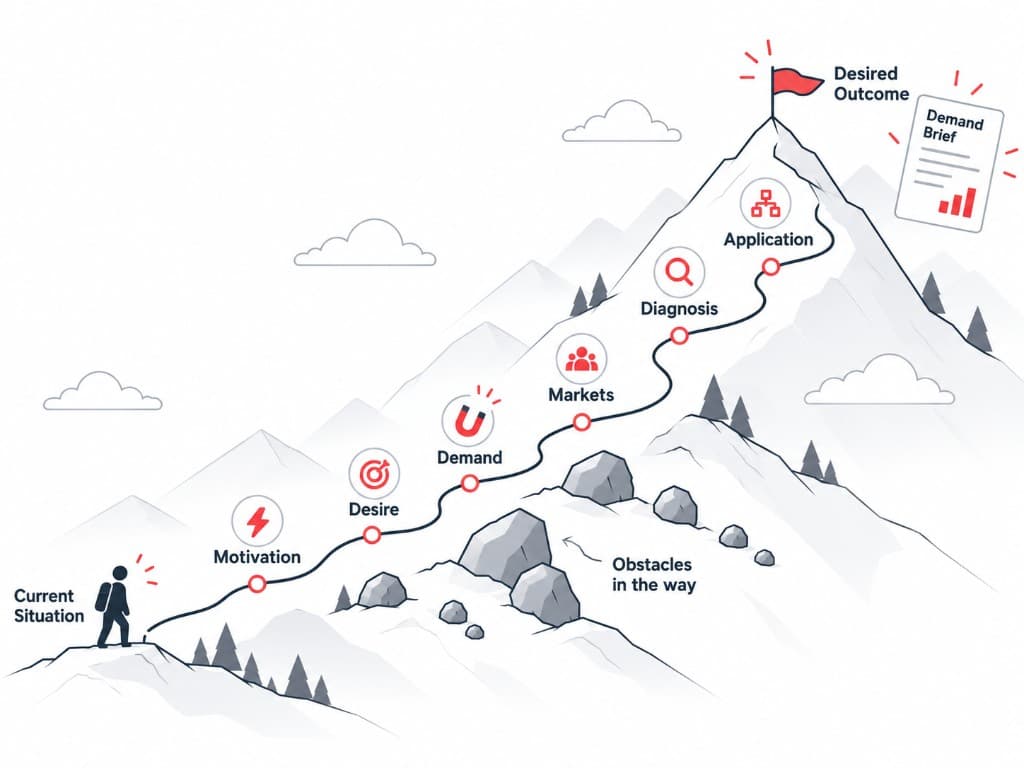
Markets
How demand develops and changes.
So far, one person at one moment. This part adds time and numbers: how demand develops in a single person, what happens after they buy, how much of it you can influence, and how many situations add up to a market.
Follow the journey from a background concern to action
How does demand develop over time?
- Dormant — the situation exists; nobody has noticed.
- Felt — something is wrong, without a name.
- Named — the problem has a name.
- Aimed — they have decided what kind of thing would help.
- Seeking — actively looking at options.
- Ready — decided, pending a trigger or an approval.
- Acting — buying.
- After — using it, or not.
Treat this as a map, not a funnel. People skip states, go backward, and loop. Match your move to where they are: someone in felt needs language; someone in seeking needs comparison; someone in ready needs the path made easy.
What happens to demand after the purchase
Is the purchase the end of the story?
Customers can drop off at four points: bought, adopted, using, benefiting. Revenue records only the first. Everything that determines whether you keep them happens in the other three.
Demand can come back through replenishment, recurring situations, maintenance, expansion, or new people entering the same situation. It can fade through resolution, changed goals, lost belief, a better substitute, or prevention upstream.
Can demand be discovered, activated, shaped, or created?
How much of this can you actually influence?
People bring their own deep concerns. You do not create those. What a business can influence is what people know, what they believe is possible, what they want specifically, and what they are able to do.
- Discover demand that already exists.
- Activate it by helping people notice and name a problem.
- Create possibilities with new capabilities.
- Let preferences spread through people who influence each other.
- Change the conditions that block action: price, risk, effort, approval, access.
If the customer could see everything you know, would they thank you?
How individual situations become a market
How do many situations add up to something you can plan against?
Ask four questions separately:
- Intensity — how much do they care?
- Prevalence — how many are in this situation?
- Frequency — how often does the need arise?
- Ability to pay — can they afford a solution?
Choosing among candidate situations is the work of the next pattern, Customers.