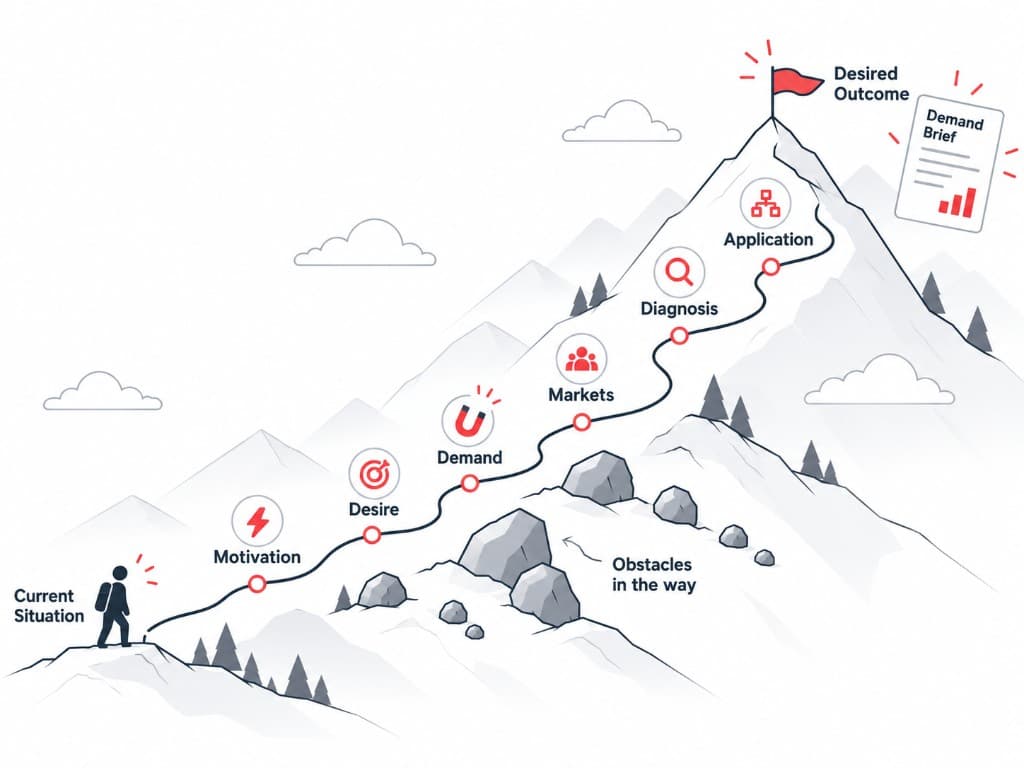
Introduction
Marketing is about change.
We want someone to buy our product, sign the contract, book the call, switch from a competitor, or give our idea a try. Sometimes we want something harder: for someone to trust us, change their mind, or see a situation the way we see it. The same basic challenge shows up whether you are selling software, raising money, asking for a promotion, or trying to get a 8 year old to brush their teeth.
In every case we are trying to help a change happen inside another person. And in every case it is easy to forget the most important part, which is: the change does not start with us. It starts inside them.
This guide is about understanding whats going on inside them.
Why this pattern comes first
Every marketing decision you make contains an assumption about what customers want.
A headline assumes a problem people recognize. A price assumes a value people perceive, compared with alternatives they already have in mind. An advertising channel assumes people are looking, or at least reachable, at a particular moment. A feature assumes an obstacle worth removing.
Businesses make these assumptions whether or not they examine them. The difference between marketing that works and marketing that flails usually is not creativity or budget. It is whether the assumptions underneath are accurate.
That is why Demand is the first of the eight patterns. The other seven patterns: Customers, Positioning, Offer, Attention, Persuasion, Brand, and Learning all build on top of it.
What you will be able to do
By the end you will be able to describe a customer's situation, what they want, and why it matters to them. You will also be able to see what stands in their way: both the obstacles between them and the outcome, and the new obstacles that appear when they consider switching to any solution, including yours. And you will know how to tell real demand from polite interest, and how to check your understanding against what people actually do.
In the end you will have one document that holds all of it, which the rest of your marketing can build on called a demand brief.
You don't need any background in marketing, psychology, or economics. Every idea is explained from scratch, in the order you'll need it.
How this is organized
We've organized this into six parts, each answering a bigger question.
- Motivation - Why do people care about anything? What are they trying to achieve and protect?
- Desire - How does someone come to want a particular outcome, and what stands in the way?
- Demand — What turns a want into action, and why doesn't it always?
- Markets — How does demand change over time, and how do many individual situations add up to a market?
- Diagnosis — How do you find out what your customers want, test it, and write it down?
- Application — How does all of this shape the rest of your marketing?
We suggest you read in order the first time. The ideas build on each other each section assumes what came before it. After that they can work as a reference.
As you read, keep one real customer in mind. Not a target market or an imaginary persona, but an actual person who bought from you, almost bought from you, or you believe might buy from you. Each section will ask you to apply the idea to that person, so that by the end you have a real demand brief rather than a theoretical one.