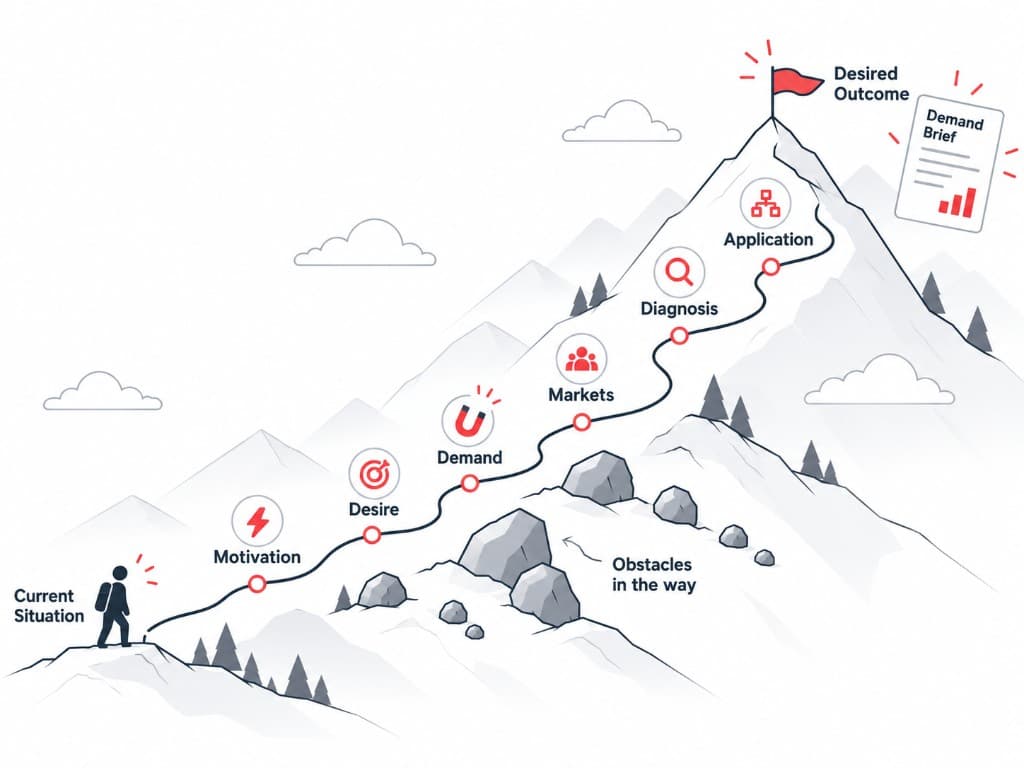
Diagnosis
Understand demand in your business.
Everything so far has been a way of looking. This part is the work: finding out what is true, testing it, and writing it down so someone else can act on it.
Learn what people want without relying on guesses
How do you find out what is actually going on?
Ask about the past, not the future. Reconstruct one specific, recent decision: before, the moment, first thoughts, the search, the hesitation, the decision, and after.
Talk to people who did not buy. Ask about what is not said. Try to prove yourself wrong. Keep comparable records.
Test whether the demand is strong enough to act on
What does research not tell you?
Research says the situation is real. A test says what people do. Name your uncertainties and test first the one that would sink the idea if you are wrong.
If we offer [specific terms] to [specific people], at least [number] will [specific action] within [time].
Match the commitment to the claim. Test real terms — price, timing, what is included — not a vague idea. Decide in advance what you will continue, revise, or stop at each level of result.
Diagnose demand and write the brief
How do you turn all of this into one page someone can act on?
Pick one recurring situation: specific enough to recognize, common enough to matter. Make two obstacle columns — obstacles to the outcome, and obstacles to adoption — before you write anything else.
Mark every claim: evidence versus inference. Check whether the real problem is even a demand problem, or Attention, Positioning, Offer, Persuasion, Experience, or Learning.
A good brief would let the customer recognize themselves, keeps your product out of the diagnosis, names both kinds of obstacles, separates evidence from inference, and leads to a decision.