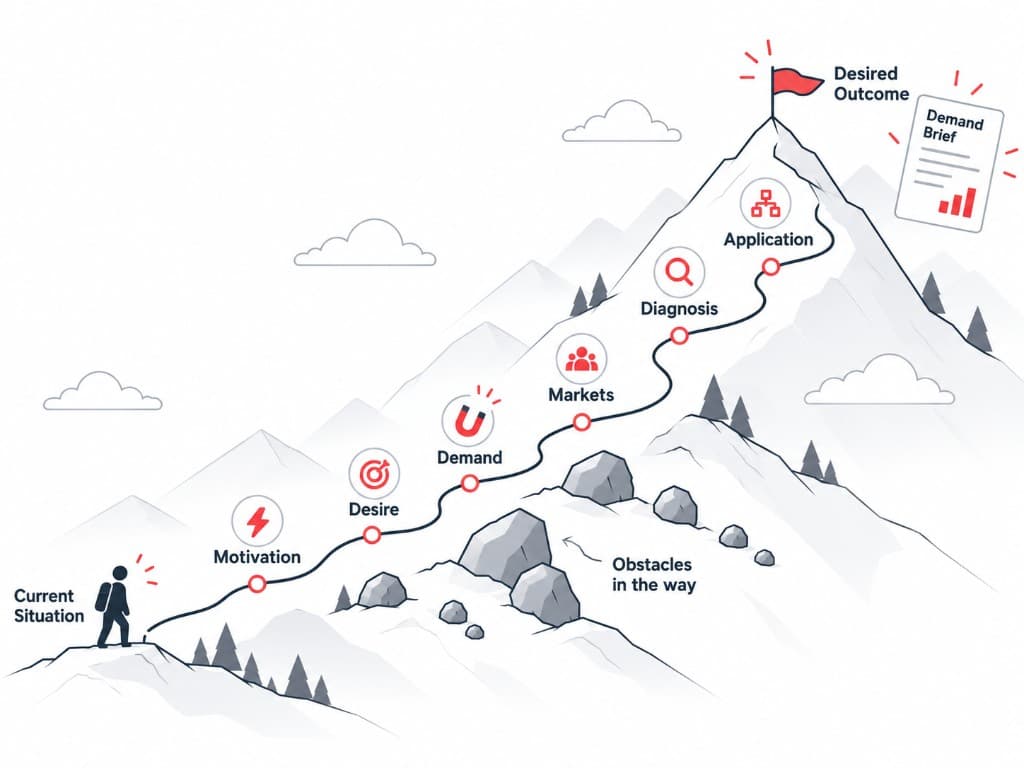
Desire
How wanting takes shape.
Knowing that something is wrong does not tell a person what to do about it. This part is about where direction comes from — how someone arrives at wanting a particular thing, what they fear, and how to describe the gap they are trying to close.
How people learn what might make things better
Where does the direction of a want come from?
Everyone carries a private map of what leads to what. Each link on that map is an association.
The map is what turns "something is wrong" into "I should try X." Without it, discomfort has no direction.
Four ways the map gets built:
- Doing. Direct experience. The strongest kind, and the hardest to argue with.
- Watching. Observed experience. Seeing someone else do it and seeing what happened to them.
- Hearing and reading. Symbolic experience. Stories, claims, advertising, reviews.
- Reasoning. Working out that something should follow from something else.
Most marketing lives in the third category, which is the weakest. That is why a free trial can outperform a year of writing, and why one specific account of what happened to a person like them beats any number of claims.
Associations come from coincidence, familiarity, and similarity as much as from real cause and effect. Treat them as evidence about the person, not evidence about the world.
The same offer can mean relief to one person and risk to another, because each is reading it through a different map. This is not irrationality. It is two people with different histories drawing correct conclusions from different evidence.
How a possible future becomes something someone wants
What is a desire, actually, and why isn't wanting enough?
People can want futures they have never lived, because the map lets them predict what something would be like.
Both are built out of associations. Both can be wrong. Both feel like knowledge.
Relief, pleasure, competence, belonging, meaning, curiosity, achievement — each lens has its own version of better. Naming which one you are offering is more useful than a general claim that things will improve.
Vague anxiety is not useful. Fears attach to specific objects: the outcome (it will not work), the method (this approach is wrong), the change itself (this will be disruptive), or something that might be lost (control, money, standing, a routine that works).
A person can want something badly and not believe they will get it, and do nothing. A person can fully believe your solution works and not care enough to act. These are different problems with different fixes.
Doubt has four possible addresses:
- That the outcome is possible at all.
- That the method works.
- That this provider can deliver it.
- That they themselves can do their part.
Most businesses only ever argue the third. The fourth is the one most often left unaddressed and most often decisive.
It is still short of action. Action also needs priority, resources, opportunity, and an acceptable path.
What customers want, and what stands in their way
How do you describe a problem in a way that is useful?
"Overwhelmed." "Disorganized." "Inefficient." Labels feel like understanding and contain none. Replace each with what actually happens, how often, what it feels like, and what it leads to.
Describe the desired outcome by how the customer would know it had happened. Something observable.
Without a picture of better, there is no problem — only circumstances. The stakes explain why closing the gap matters.
People rarely buy a product for its own sake. They buy a change, from where they are to where they want to be.
Every outcome has three dimensions:
- Functional — what they can do or have.
- Emotional — how they will feel.
- Social — how they will be seen, and who they will be.
The destination is what sells. The obstacles are what tell you what to build. If your solution does not remove the actual obstacles, it will not help, no matter how appealing the destination sounds.
Write the problem down in a form the customer could read and correct, with no mention of your solution. If you cannot describe the problem without yourself in it, you do not yet understand it.