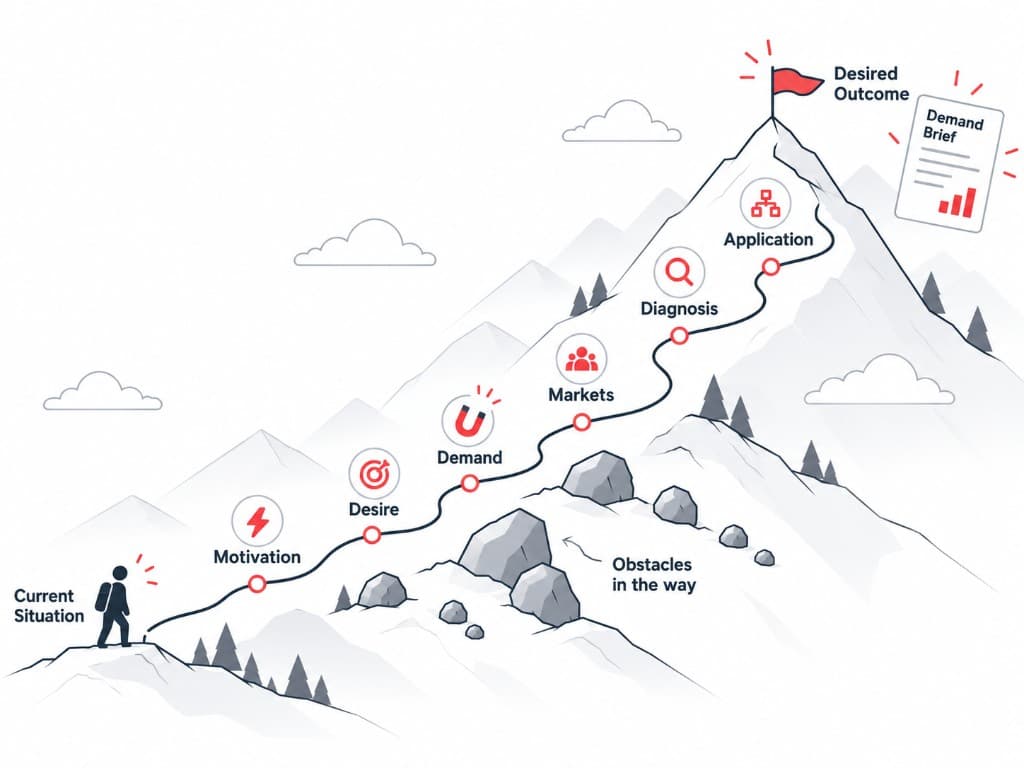
Application
Put the diagnosis to work.
You now have a way of describing the inside part. This last section is about what it is for.
Every decision rests on an assumption about demand
Think about the ordinary decisions a business makes in a week. What to say on the homepage. What to charge. Which customers to chase. Whether to run ads, and where. What to build next. How to answer a hesitant prospect.
Every one contains an assumption about what customers want. The brief makes those assumptions visible, so they can be argued about on the merits and corrected when they are wrong.
What Demand hands to the other seven patterns
- Customers — candidate situations, how often the need recurs, what people can pay, and who is involved in a purchase.
- Positioning — the alternatives they actually compare you against, and what the current way does well.
- Offer — the outcome in their words, the obstacles your solution must remove, and the terms they proved willing to accept.
- Attention — the moment, the window, and the language they use while searching.
- Persuasion — the four forces, the specific fears, and which belief is weakest.
- Brand — what they are protecting, what they'd be embarrassed by, and what a good outcome means socially.
- Learning — the marked claims. Every question mark is something your results can answer.
The loop
The patterns form a loop. Results become evidence that corrects the diagnosis, which changes everything built on it. The work is never finished. It is kept current.
What to do on Next
- Pick one real customer and write a progress statement about them.
- Show it to them, or to someone in the same situation, and let them correct it.
- Fill in the two obstacle columns.
- Mark what you know from what you are guessing.
- Write one sentence for each of the other seven patterns: Because we believe [something in the brief], we will [do something specific].
- Find the sentence resting on your shakiest evidence. That is your next test.
One last thing
The same understanding can help or exploit. Everything here works just as well for someone who wants to manufacture a fear as for someone who wants to relieve a real one.
If the customer could see everything you know, would they thank you?
Up next: Customers — which of these situations should you build a business around, and how do the different people involved in a purchase actually decide?